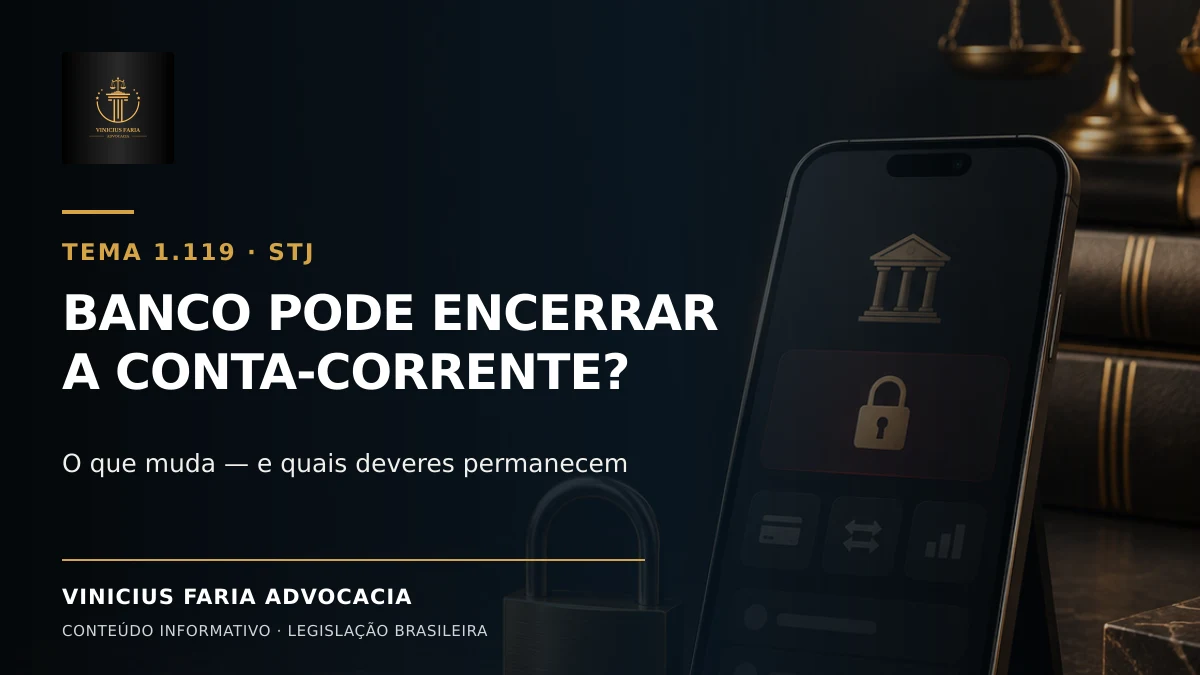
A bank’s decision to close a current account often raises questions, particularly when the customer still uses it to receive salary payments, pay expenses or maintain related products. In September 2026, Brazil’s Superior Court of Justice (STJ) resolved a central legal issue under the repetitive-appeals procedure.
In Repetitive Theme 1,119, the STJ’s Second Section held that article 39(IX) of Brazil’s Consumer Protection Code does not apply to a bank’s unilateral termination of a current-account agreement. The judgment was delivered on September 3, 2026, in Special Appeal 1,941,347/SP.
What did STJ Theme 1,119 decide?
Article 39(IX) generally treats a supplier’s refusal to provide a product or service to a customer willing to pay as abusive. The STJ held that this rule concerns refusal before the relationship begins and does not generally prevent the termination of an ongoing banking relationship governed by special Brazilian financial-system rules.
As a repetitive precedent, the holding must guide other Brazilian cases involving the same legal issue. Proceedings stayed while the theme was pending may resume.
The decision does not allow a bank to block access, retain funds or close an account without notice and without following regulatory procedure. The STJ expressly maintained the duties of transparency, information and prior notice.
What does CMN Resolution 4,753/2019 require?
CMN Resolution 4,753/2019, as amended, governs the opening, maintenance and closure of deposit accounts in Brazil. When communicating its intention to close an account, the institution must, among other matters:
- state its intention to terminate the agreement and, when required by law or regulation, provide the reasons;
- allow the account holder to designate where any remaining credit balance should be sent;
- request the return or cancellation of unused checks, if applicable;
- state the period for the required steps, capped at 30 calendar days from the notice;
- explain outstanding commitments and the effects on other contracted products or services;
- confirm the closure date or, if closure cannot be completed, explain why.
These requirements help prevent funds, automatic payments, recurring charges and related products from being left unresolved. The account agreement and the communication channels used should also be reviewed.
When is closure mandatory?
Brazilian regulation sometimes requires, rather than merely permits, closure. CMN Resolution 5,261/2025 amended article 6 of Resolution 4,753/2019 and expanded mandatory-closure grounds as of December 1, 2025.
They include serious irregularities in account-holder information that are not corrected and use of an account to provide financial or payment services without legal authorization or contrary to regulation. The Central Bank of Brazil cites so-called pooled accounts, used to move third-party funds in a manner that conceals or replaces those parties’ financial obligations.
The institution must use documented, internally approved criteria and retain the relevant records for the regulatory period. These provisions do not make every unusual transaction an automatic justification; the stated ground and the corresponding procedure must be checked.
Must the bank state a reason?
Theme 1,119 recognizes unilateral termination, including for commercial reasons, but does not remove information duties or case-specific rules. When closure relies on article 6 or another legal or regulatory ground, the resolution requires the reasons to be communicated.
Relevant facts may include the content and timing of the notice, the treatment of the balance, continued access to essential services, salary or benefit deposits, outstanding commitments, and any opportunity to correct account-holder information.
Does closure automatically result in compensation?
No. The validity of the closure and any compensable harm depend on the facts and evidence. A properly notified and completed closure does not by itself create a duty to compensate. An improperly retained balance, absent notice, contradictory information or breach of regulatory duties may require a specific assessment.
The right to terminate an agreement must not be confused with permission for unlawful discrimination, abusive denial of access to funds or disregard of special rules governing salary accounts, benefits and linked products.
Which records should be kept?
- the closure notice and proof of when it was received;
- the account agreement and amendments;
- statements and proof of the existing balance;
- service reference numbers and the institution’s responses;
- records of automatic payments, salary, benefits and linked products;
- proof of the account designated to receive the remaining balance;
- requests to correct information and documents sent to the bank.
These records help establish whether prior notice was given, which ground was stated, how the balance was handled and whether the regulatory duties and time limits were followed.
Conclusion
STJ Theme 1,119 removed article 39(IX) of the Brazilian Consumer Protection Code as a general barrier to unilateral current-account closure. It did not create an unrestricted power: banks remain subject to CMN regulation, prior notice, transparency and contractual duties. Each situation depends on the stated reason, the procedure followed and the available documents.
OAB/RJ 189.329
Rio de Janeiro — Brazil
Official sources
- Brazilian Superior Court of Justice — institutional report on Theme 1,119 (Portuguese);
- STJ Case Law Bulletin 901 — Special Appeal 1,941,347/SP (Portuguese);
- Central Bank of Brazil — CMN Resolution 4,753/2019, as amended (Portuguese);
- Central Bank of Brazil — CMN Resolution 5,261/2025 and mandatory closure (Portuguese).